
For decades, the standard approach to hydronic systems has been a control valve at each coil paired with a manual balancing valve, then a technician working through the building to set flow at every terminal. That approach works under one condition, but it carries costs that show up at every stage of a building’s life: in the design, during commissioning, and on the utility bill every year after. Pressure-independent control valves, or PICVs, change the math at each of those stages.
This guide walks through where those savings come from, starting with first costs and ending with the yearly operating savings that matter most to building owners.
How Traditional Hydronic Balancing Works
In a conventional system, each coil has a standard control valve that modulates flow in response to the building automation system, plus a separate balancing valve set during commissioning to limit maximum flow. The problem is that a standard control valve’s flow depends on the pressure across it. As other valves in the system open and close, pressure shifts, and the flow through every other coil changes with it. Balancing valves set a fixed maximum flow at one operating condition, but buildings rarely sit at that condition for long.
What Makes a PIC Valve Different
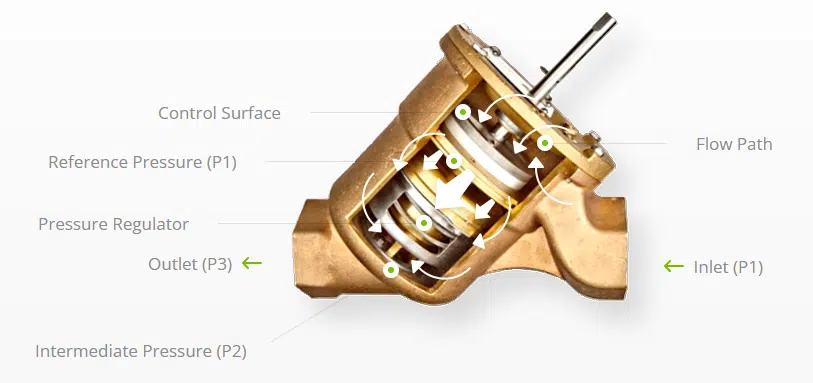
A pressure-independent control valve combines a control valve with a built-in mechanical differential pressure regulator. The regulator holds a constant differential pressure across the control portion of the valve, so the flow through the coil depends only on the valve position the BAS commands, regardless of what’s happening elsewhere in the system. In practice, each PICV is its own balancing device across the entire flow range, from full load down to minimum flow.
Upfront Savings: Smaller Pipes, Smaller Pumps, Higher Delta T
Designing Around True Flow
Conventional designs usually build in extra flow to make up for coils that end up overflowing or starved once the system is operating. Because a PICV delivers its set flow at each coil no matter how system pressure shifts, engineers can design closer to the true flow the building needs.
Larger Delta T Means Less Water to Move
When coils receive the right flow instead of excess flow, the water leaving each coil returns at a temperature at or above design, which supports a larger design delta T. A larger delta T means the same amount of heating or cooling can be delivered with less water. Less water can translate into smaller pipe sizes and smaller pumps, which reduces material and equipment costs before the building ever opens.
Fewer Components at Every Coil
A PICV replaces the separate control valve and balancing valve at each coil with a single assembly. That means fewer valves to purchase, fewer connections to make, and less labor per coil during installation.
Balancing and Commissioning Savings
With traditional valves, balancing is a building-wide process. A technician measures and adjusts flow at each valve, and because every adjustment affects the others, the process often takes several passes. A system built around PICVs removes the need to balance at every valve point. Each valve is set to its design flow, and spot checks can be done using the pressure ports built into the valves; on large projects with hundreds of coils, that can remove a significant amount of time from the commissioning schedule.
Yearly Savings: Holding Delta T at Partial Loads
The largest savings come after the building is occupied. Most buildings spend the majority of their operating hours at partial load, which is exactly where conventional systems struggle. As standard control valves throttle, pressure across the remaining open valves rises, coils overflow, and the return water temperature drops. This is commonly called low delta T, and it forces pumps, chillers, and boilers to move more water and run less efficiently than designed.
Because a PICV controls flow accurately across its entire range, coils receive only the flow they need at every load condition. The system holds its delta T at or above design during partial load hours, pumps on variable speed drives can slow down, and central plant equipment operates closer to its intended efficiency. Those savings repeat every year the building operates.
Verifying the Savings
Claims about energy savings are only as good as the data behind them. The DeltaP SmartValve from Flow Control Industries pairs a pressure-independent control valve with built-in instrumentation, so the valve that controls flow at the coil also measures it. Each SmartValve provides real-time BTU measurements, flow, supply temperature, return temperature, delta T, and pressure directly from the valve. Owners get a measured record of how each coil is performing, so improvements can be tracked and documented over time instead of estimated. You can see how this fits into our hydronic flow and energy measurement applications.
Is a PIC Valve the Right Fit?
PICVs offer the most benefit in variable flow systems where loads change throughout the day, which describes most commercial, healthcare, and campus buildings. LABS represents Flow Control Industries DeltaPValve, a pressure-independent control valve, and our team can help evaluate whether a project’s design, existing piping, and control sequence are a good match. Our case studies show how these valves perform in real buildings.
If you’re designing a new hydronic system or looking for ways to correct low delta T in an existing one, request a quote and our team will help you size and select the right valves for the application. We can also provide performance-based specification language through our services.
Frequently Asked Questions
What is a pressure independent control valve?
A pressure independent control valve combines a control valve with a built-in mechanical differential pressure regulator, so the flow through the coil stays at the commanded rate regardless of pressure changes elsewhere in the system.
Do PIC valves eliminate the need for hydronic balancing?
PICVs remove the need to balance at every valve point. Each valve is set to its design flow and can be spot checked using its built-in pressure ports, rather than adjusted through a building-wide balancing process.
How do PIC valves reduce upfront costs?
By holding accurate flow at each coil, PICVs support a larger design delta T, which can allow smaller pipe and pump sizes. They also replace the separate control and balancing valves at each coil with a single assembly, reducing installation and balancing labor.
What is low delta T and how do PIC valves help?
Low delta T happens when coils overflow at partial load, causing return water to come back cooler (or warmer, in heating) than designed. PICVs control flow accurately across the full range, which helps the system achieve higher design delta T and improves central plant efficiency.
Are PIC valves a good fit for constant flow systems?
PICVs deliver the most benefit in variable flow systems, where loads and pressures change throughout the day. Constant flow systems can still benefit, but the operating savings are typically smaller.