
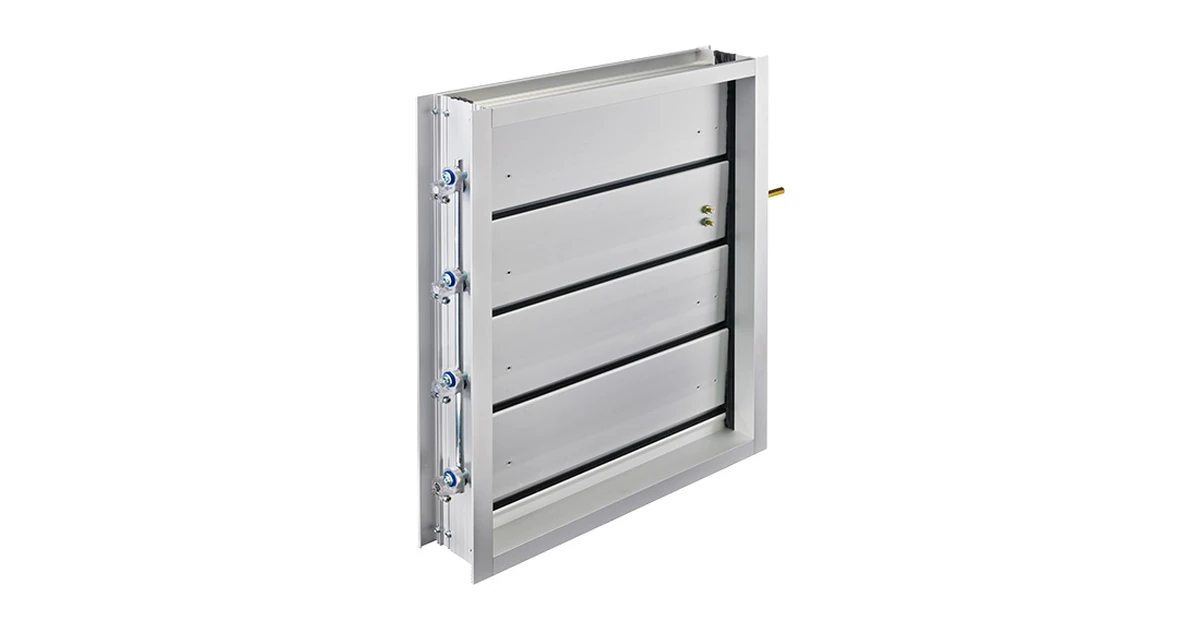
Every air handler depends on its control dampers to decide how much outside air comes in, how much return air gets recirculated, and how much conditioned air goes out to the building. When those dampers are sized correctly, seal tightly, and respond accurately to the control system, the air handler can do what it was designed to do. When they leak, stick, or drift, the building pays for it in energy, comfort, and ventilation.
This guide covers what control dampers do at the air handler, how each position in the system works, and what to look for when specifying or replacing them.
What Are Control Dampers?
Control dampers are motorized assemblies installed at the air handler or in its connected ductwork to regulate airflow in response to a signal from the building automation system. An actuator drives a set of blades open, closed, or anywhere in between, allowing the system to adjust airflow continuously as conditions change. In a typical air handler, control dampers sit at three key points: the outside air intake, the return air path, and the supply or discharge side.
Control dampers at the air handler serve a different purpose than VAV boxes and terminal units, which regulate airflow to individual spaces downstream. Air handler control dampers manage the air entering, leaving, and mixing within the unit itself, which is where some of the largest energy and ventilation decisions in a building are made.
How Control Dampers Work at the Air Handler
Outside Air Dampers
The outside air damper controls how much fresh air enters the building. It has to deliver at least the minimum ventilation required by ASHRAE Standard 62.1 and the project design, while avoiding bringing in more outside air than necessary, since every extra cubic foot has to be heated, cooled, or dehumidified. During economizer operation, the outside air damper fully opens to use cool outdoor air for free cooling. Because it does so much work and faces the outdoors directly, the outside air damper is usually the most demanding position in the system.
Return Air Dampers
The return air damper controls how much air coming back from the building is recirculated through the air handler. It typically works in coordination with the outside air damper so that as one opens, the other closes, keeping the mixed air at the right ratio and temperature. If the return damper doesn’t track properly, the mixed air drifts off target, and the coils work harder to compensate.
Supply Air Dampers
Supply air dampers regulate or isolate airflow leaving the air handler. Depending on the system, they may be used to isolate units in a multi-fan arrangement, shut off airflow when the unit is down, or help control airflow and pressure on the discharge side.
Opposed-Blade vs. Parallel-Blade Control Dampers
Blade operation affects far more than the direction the blades turn. According to TAMCO’s white paper on damper blade operation, most field complaints about control dampers, such as whistling, vibrating blades, or a damper that won’t deliver the expected airflow when partly open, trace back to system design or application choices rather than a defective damper. Choosing the right blade action is one of the most important of those choices.
How Airflow Responds to Blade Position
Neither blade type gives a one-to-one relationship between blade rotation and airflow. As opposed blades open, the free area between them grows slowly at first and then increases quickly beyond about 70 percent open. Parallel blades open more evenly, so their airflow tracks blade position much more closely, especially between 0 and 75 percent flow.
Where Each Type Fits
- Parallel-blade dampers suit control sequences set up for a linear response, and they are the better choice whenever air needs to be redirected, such as directly upstream of an elbow. In an air handler mixing box, parallel-blade outside air and return air dampers installed at 90 degrees to each other, with the blades opening toward each other, force the two airstreams together and prevent temperature stratification.
- Opposed-blade dampers perform best when open between 45 and 90 degrees, and they are the most suitable choice when linear airflow is required and the damper runs above 50 percent open. They need a control signal built around a curved response to produce predictable airflow.
Setting Minimum Outside Air
Holding an accurate minimum outside air setpoint with a single large opposed-blade damper is difficult. In TAMCO’s example, an opposed-blade damper has to open to roughly 45 percent to deliver 15 percent airflow. A more reliable approach pairs a small parallel-blade damper on a two-position actuator with a larger opposed-blade damper on a modulating actuator. It costs more, but it is easier to set up and control.
Torque and Leakage
Parallel-blade dampers can require up to 35 percent more torque to open than opposed-blade dampers, which affects actuator sizing. TAMCO’s parallel and opposed blade control dampers have identical leakage rates, but that is not the case for every manufacturer, so when leakage is critical, check the published data for the blade action being specified.
The best choice depends on where the system will operate most of the time, which is the first question to answer before specifying blade action.
Why Damper Leakage Matters
A control damper that doesn’t seal tightly when closed lets air through that the control system thinks it has stopped. On an outside air damper, that means unconditioned air leaking in during unoccupied hours, extra heating and cooling load, and in cold climates, a higher risk of freezing coils. Energy codes such as ASHRAE Standard 90.1 set maximum leakage requirements for outdoor air and exhaust dampers for exactly this reason. Specifying low leakage dampers certified under AMCA’s Certified Ratings Program gives engineers and owners confidence that the damper’s published leakage and performance ratings have been independently verified. For outside air applications, TAMCO’s Series 9000 BF control damper uses a thermally broken frame and blades to help limit heat transfer and condensation across the damper.
Actuators and Control Integration
A control damper is only as accurate as the actuator driving it and the signal behind it. Actuator selection depends on the torque required to move the blades against system pressure, the type of control signal used, and whether the damper needs to fail open or closed on a loss of power. Undersized actuators or worn linkages are a common reason a damper reports one position to the building automation system while sitting in another. TAMCO also provides motor mounting kits for fitting actuators to its dampers.
Pairing Control Dampers with Airflow Measurement
A damper position tells you where the blades are, but it doesn’t tell you how much air is actually moving. Pairing outside air control dampers with an airflow measurement station allows the building automation system to control to an actual measured airflow rather than an assumed one. That’s what makes it possible to verify minimum ventilation is being met, and to keep the building from over-ventilating and wasting energy. For more on how this works, see our guide to [airflow monitoring and energy savings](LINK TO BLOG 1 ONCE LIVE).
Signs Your Air Handler Control Dampers Need Attention
A few patterns tend to point back to the dampers: energy bills rising without an obvious cause, mixed air temperatures that don’t match what the controls expect, economizers that never seem to deliver free cooling, coils tripping on freeze protection in cold weather, or ventilation readings that can’t be confirmed. Dampers with visible blade damage, worn seals, or actuators that hunt or stall are also strong candidates for replacement. Seal material plays a large part in how long a damper holds its leakage performance, and TAMCO’s cycle testing of its silicone jamb seals has passed two million cycles.
Choosing the Right Control Dampers
The right control damper starts with the application, whether it’s outside air, return air, or supply air, since each position places different demands on leakage, control accuracy, and durability. From there, size, pressure rating, leakage class, blade design, and actuator selection all need to match the air handler and the control sequence. Getting those details right at the specification stage is what allows the system to run as designed for years after installation.
TAMCO’s airfoil control dampers, including the low leakage Series 1000 and ultra low leakage Series 1500, cover most outside air, return air, and supply air positions at the air handler.
You can see the full range of air control damper applications we support, including outside air, heavy-duty, and mission-critical installations. If you’re specifying or replacing control dampers for an air handler project, request a quote and our team will help with product selection, submittals, and specification language so the dampers perform the way the design calls for.
Frequently Asked Questions
What do control dampers do in an HVAC system?
Control dampers regulate airflow at the air handler by opening, closing, or modulating in response to the building automation system. They manage how much outside air enters, how much return air is recirculated, and how air leaves the unit.
What is the difference between an outside air damper and a return air damper?
An outside air damper controls how much fresh air enters the air handler, while a return air damper controls how much building air is recirculated. The two typically work together to maintain the correct mix of outside and return air.
Are air handler control dampers the same as VAV dampers?
No. VAV boxes and terminal units regulate airflow to individual spaces downstream of the air handler, while air handler control dampers manage the outside, return, and supply air at the unit itself.
Should I use opposed-blade or parallel-blade control dampers?
It depends on where the damper will operate most of the time. Parallel blades give a more linear response at lower flows and are the better choice for mixing boxes and redirecting air, while opposed blades perform best above about 50 percent open with a control sequence built for a curved response. TAMCO’s white paper on damper blade operation covers the selection in detail.
Why does damper leakage matter?
Leakage allows air to pass through a damper the control system believes is closed. On outside air dampers, this adds heating and cooling load, wastes energy, and in cold weather can increase the risk of frozen coils. Energy codes set leakage limits for outdoor air dampers for this reason.
Should outside air dampers be paired with airflow measurement?
Pairing outside air dampers with an airflow measurement station allows the control system to manage actual measured airflow rather than relying on damper position alone, which is the most reliable way to verify minimum ventilation and avoid over-ventilating.