
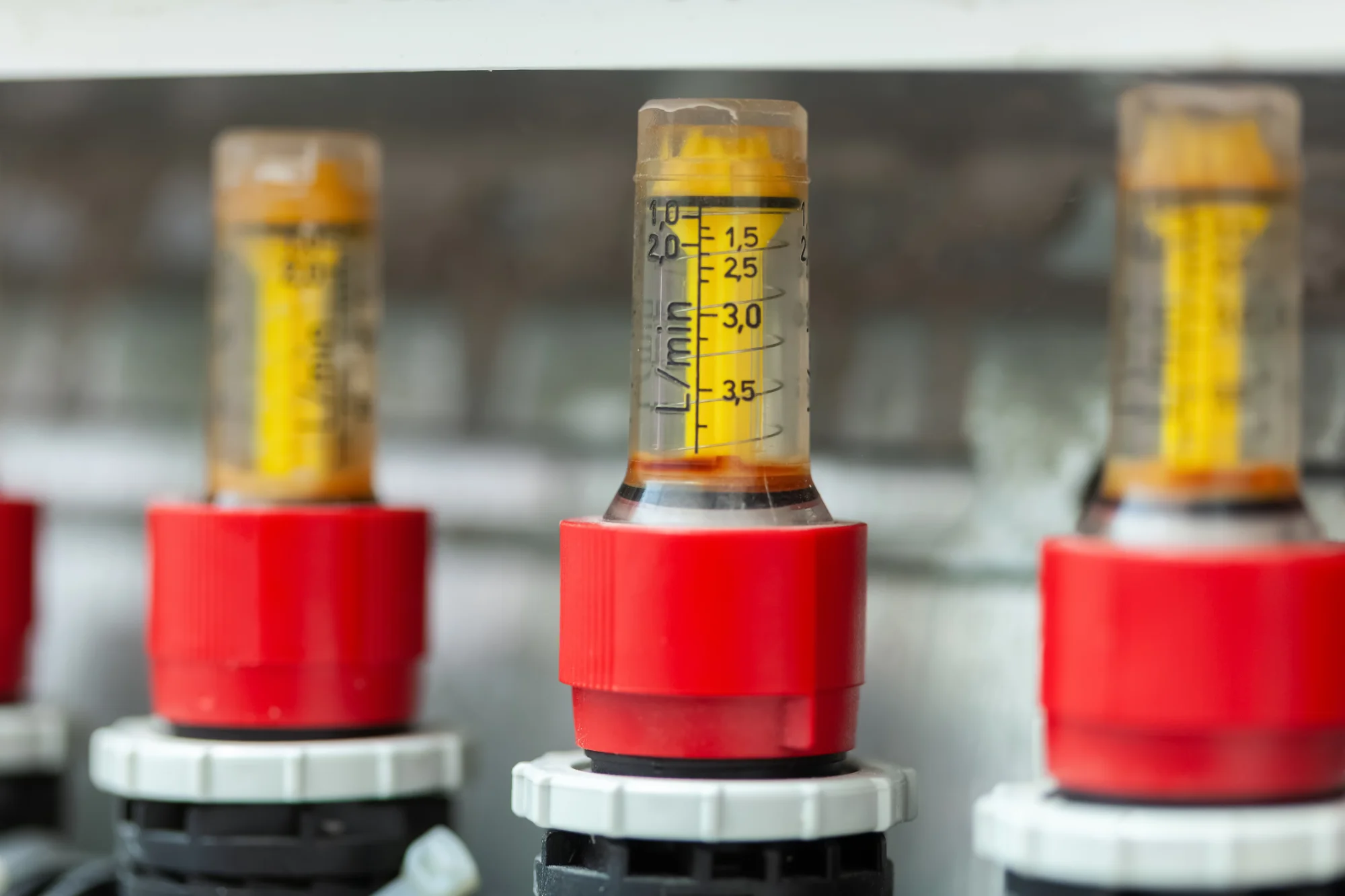
Choosing a flow meter is a solvable problem. Once you know what is in the pipe, what the installation will allow, and what the measurement is actually for, the field of options narrows quickly, and the right technology usually becomes obvious.
Those three inputs do most of the work. The fluid rules technologies in or out on principle. The installation conditions — pipe size, available straight run, whether the system can be drained — decide what can physically go in. And the intent of the measurement decides how much accuracy you need to buy: a meter feeding a tenant invoice, a meter driving a control sequence, and a meter monitoring performance for troubleshooting are three different requirements, and treating them as one requirement is how projects end up over-specified in one place and under-specified in another.
Flow measurement carries real weight in a commercial building. EIA data show that cooling and ventilation together account for roughly a third of electricity use in U.S. commercial buildings, and the water and air moving through those systems are what your meters are measuring. Getting the selection right at the design stage is far cheaper than correcting it at startup.
This guide walks through the main flow meter technologies used in building systems, explains what each one does well and where it fits, and gives you a practical way to narrow the options based on the pipe you actually have.
What This Guide Covers
- What flow meters do in a building system
- The main types of flow meters used in commercial buildings
- How to choose between types of flow meters
- Flow meter comparison table
- Matching technologies to common building applications
- What causes a good flow meter to give bad data
- Writing a specification that holds
- Frequently asked questions
What Flow Meters Do in a Building System
Before comparing technologies, two distinctions clear up most of the confusion.
Volumetric Versus Mass Flow Measurement
Volumetric meters measure how much space the fluid occupies as it passes, typically in gallons per minute. Mass flow meters measure how much matter passes, typically in pounds per hour. For water in a closed hydronic loop, volumetric measurement is usually sufficient because density is stable and predictable.
For gases, that stops being true. Density changes with temperature and pressure, so a volumetric reading on a gas line means little without correction. That is why gas applications tend toward mass measurement.
Flow Measurement Versus Energy Measurement
A flow meter tells you how much fluid moved. It does not tell you how much heating or cooling that fluid delivered. Energy measurement requires flow plus a temperature differential across the load, which is the function of thermal energy (BTU) meters. Thermal energy monitoring and tenant submetering are separate applications built on top of flow measurement.
This matters when reading a specification. If the spec calls for energy measurement and the submittal shows a flow meter alone, the submittal is short.
The Main Types of Flow Meters Used in Commercial Buildings
Five technologies cover the great majority of building system applications.
Electromagnetic Flow Meters
Electromagnetic flow meters apply Faraday’s law of induction. A magnetic field is generated across the flow path, and as conductive fluid passes through it, a voltage develops proportional to velocity. Electrodes read that voltage, and the transmitter converts it to flow rate.
They come in both inline and insertion configurations. Inline models replace a section of pipe and measure across the full cross section. Insertion models enter through a tap and measure along a single path, which allows installation on an operating system via hot tap and avoids cutting a pipe section out.
Strengths: no moving parts, no obstruction in the flow path, no pressure drop, excellent low flow performance, and wide turndown. Available across a broad range of pipe sizes in both configurations.
Limitations: the fluid must be electrically conductive, which rules out gases, steam, and deionized water. Inline models require the system to be drained and a pipe section removed.
Best fit: chilled water, hot water, and condenser water loops where accuracy matters and variable flow means low velocity operation is routine. Electromagnetic technology suits both closed and open loop hydronic service. It appears throughout the flow and energy products we represent.
Ultrasonic Flow Meters
Ultrasonic flow meters send sound pulses through the fluid and read velocity from the result. Transit time designs compare how long pulses take traveling with the flow against traveling against it.
Like electromagnetic meters, they come in more than one configuration. Inline ultrasonic meters install as a pipe section. Clamp-on ultrasonic meters mount on the outside of the pipe, with no penetration at all.
Strengths: clamp-on flow meters mount on the outside of the pipe, which means no pipe cut, no shutdown, and no pressure drop. Note that the no pressure drop advantage belongs to the clamp-on style specifically, since an inline ultrasonic meter sits in the flow path. That makes clamp-on designs valuable for retrofits, for temporary measurement during balancing, and for large-diameter pipe where inline meters get expensive.
Limitations: transit time designs need reasonably clean fluid. Straight run still has to be respected, the same as any other technology.
Best fit: retrofits, applications where welding or hot tapping is not an option, and temporary or portable measurement during balancing and troubleshooting. Also suits clean closed-loop hydronic service in inline form.
Turbine Flow Meters
Turbine flow meters place a rotor in the stream and count its rotations. In building systems, these are typically insertion designs, entering through a tap on the pipe.
Insertion turbines are available across essentially the full range of pipe sizes used in hydronic systems, from roughly one inch upward. Pipe size is not what separates them from electromagnetic meters — the two overlap almost completely on size — and neither is straight run, which is comparable to an insertion electromagnetic meter or a clamp-on ultrasonic. Pressure drop from an insertion turbine is negligible.
Strengths: well established, widely understood, and cost-effective. Insertion designs can be installed via hot tap on an operating system, which makes them a real option for retrofits that cannot be drained.
Limitations: the rotor has moving parts and bearings, so debris is the constraint that matters. Open-loop systems such as condenser water carry material that can foul or clog a turbine, which makes them a poor fit there.
Best fit: clean, closed-loop hydronic systems — chilled water and hot water — where the fluid is treated, and debris is not a factor.
Vortex Flow Meters
Vortex meters place a bluff body in the stream. Fluid passing it sheds alternating vortices at a frequency proportional to velocity, and a sensor counts that frequency.
Strengths: no moving parts, handles high-temperature service well, and works on liquids and steam with the same operating principle. Steam is where vortex meters earn their reputation in building systems.
Limitations: there is a minimum Reynolds number below which vortex shedding becomes irregular, and measurement fails, so low flow turndown is limited. Straight run requirements are meaningful, and the bluff body creates a pressure drop.
Best fit: steam and condensate service, and high-temperature hot water.
Thermal Dispersion Flow Meters
Thermal dispersion meters, also called thermal mass flow meters, heat a sensor and measure how much heat the passing fluid carries away. Because heat transfer depends on the mass passing the sensor, the output is a direct mass flow reading without needing separate temperature and pressure correction.
Strengths: direct mass measurement, strong low flow sensitivity, no moving parts, and minimal pressure drop. Turndown is typically excellent for gas service.
Limitations: gas composition affects the reading, so a meter calibrated for one gas will misread another. Not suited to liquid service in building applications.
Best fit: natural gas, compressed air, and other gas lines. Compressed air submetering for leak detection is a common and quickly profitable use.
How Do You Choose Between Types of Flow Meters?
Five questions narrow the field faster than any comparison chart.
What Fluid Is in the Pipe
This is the first filter, and it eliminates most of the field on its own:
- Clean, closed-loop hydronic systems — chilled water and hot water — can use turbine, electromagnetic, or ultrasonic meters. All three are valid, and the choice comes down to installation conditions and budget.
- Open-loop hydronic applications — condenser water and similar — can use electromagnetic or ultrasonic. Debris rules out turbine.
- Steam and high-temperature hot water call for vortex shedding.
- Gases and compressed air call for thermal dispersion.
Glycol content changes fluid properties and needs to be declared, because it affects both measurement and any downstream energy calculation.
Pipe Size, Access, and Available Straight Run
Straight run is the constraint that most often forces a decision. Nearly every flow measurement technology needs a developed, symmetric flow profile to deliver rated accuracy, and upstream elbows, tees, reducers, and valves disturb that profile. Requirements are expressed in pipe diameters upstream and downstream, and they differ by technology, but no technology is exempt from the requirement.
Measure what you actually have at the intended location before selecting. Discovering during startup that a meter needs ten diameters upstream in a space that offers four is an expensive way to learn this.
Turndown and Low Flow Performance
Design flow is the condition a building rarely operates at. Variable flow pumping means low velocity operation for much of the year, and several technologies lose accuracy or stop registering there. Compare each candidate’s turndown against the real operating range rather than the schedule value.
Installation Type and Whether the System Can Be Drained
New construction places no real constraint here. Inline, insertion, and clamp-on meters are all viable, and the decision can be made on other grounds.
Retrofits are where installation type starts to matter. If the system will be drained, any configuration is still on the table. If it will not be, the options narrow to a hot-tapped insertion meter or a clamp-on ultrasonic. Both are established approaches, and the choice between them is usually about whether the pipe can be tapped rather than about accuracy.
What Signal the Building Automation System Needs
Confirm the protocol before selecting: BACnet, Modbus, pulse output, or analog. A meter that measures beautifully and cannot communicate with the automation system solves half the problem. This is also where the intent of the measurement resurfaces — billing, control, and monitoring have different integration and documentation expectations.
Flow Meter Comparison Table
| Technology | Typical accuracy | Straight run need | Pressure drop | Best building application |
| Electromagnetic, inline | High | Low to none | Low to negligible | Chilled water, hot water, condenser water |
| Electromagnetic, insertion | High | High | Low to negligible | Large pipe hydronic service where inline is impractical |
| Ultrasonic, inline | High | Moderate | Moderate | Clean water loops, large pipe |
| Ultrasonic, clamp-on | Moderate | Moderate | None | Retrofits, temporary measurement |
| Turbine and insertion turbine | Moderate to high | High | Low to negligible | Clean water, large pipe on a budget |
| Vortex | Moderate to high | High | Moderate to high | Steam and condensate |
| Thermal dispersion, insertion and inline | Moderate to high | Moderate to high, depending on flow conditioner | Low to moderate, depending on style | Natural gas, compressed air |
Straight run and turndown figures vary by model and size. Always work from the manufacturer’s published specification for the specific model, and confirm it against the conditions at your intended installation location.
Matching Flow Meter Types to Common Building Applications
Chilled Water and Hot Water Loops
These are clean, closed-loop systems, which means all three water technologies are candidates. Electromagnetic meters handle low-velocity operation well and add no pressure drop. Insertion turbines are cost-effective and install via hot tap. Ultrasonic meters, inline or clamp-on, suit situations where the pipe should not be penetrated at all. Whichever you choose, confirm the low end of its usable range against shoulder season flow rather than the design condition.
On hot water systems, add temperature rating as a check. Confirm the meter’s maximum fluid temperature covers the design supply temperature with margin, and confirm the electronics can handle ambient conditions in the space where they will live.
Condenser Water and Open Loop Systems
Electromagnetic and ultrasonic meters are the appropriate choices here. Open loop water carries debris that can foul a turbine rotor, so turbine designs should be kept out of this service regardless of how well they perform elsewhere.
Steam, Condensate, and High Temperature Hot Water
Vortex meters dominate this service. Density compensation matters, since steam density varies with pressure and temperature, and an uncompensated volumetric reading on steam is close to meaningless for energy accounting.
Gas and Compressed Air
Thermal dispersion meters suit both. On compressed air, submetering by branch frequently reveals leak losses large enough to justify the meters within a year.
Airflow and Ventilation
Duct-mounted airflow measurement is its own discipline with its own technologies, and it deserves separate treatment rather than a paragraph here. Airflow measurement and outside air control is a distinct application area, and minimum outside air measurement in particular depends on accuracy at minimum position rather than at design airflow.
What Causes a Good Flow Meter to Give Bad Data?
The meter is usually not the problem.
Insufficient Straight Run and Profile Disturbance
An elbow four diameters upstream of a meter that needs ten produces swirl, and the meter reads swirl as flow. Where straight run cannot be found, a flow conditioner or a technology with lower requirements is the answer, not hoping the error averages out.
Low Velocity Operation Below the Usable Range
A meter operating below its minimum velocity does not report a slightly wrong number. It reports something unrelated to reality, or nothing at all. Check the low end against actual part load conditions.
Installation Orientation and Air Entrainment
A partially full pipe or entrained air corrupts nearly every technology. Vertical runs with upward flow help keep the pipe full. Mounting the meter at a high point in the system invites trapped air, which is a slow and frustrating problem to diagnose.
Skipping Commissioning and Verification
A meter that was never verified against a reference is a meter nobody should trust. ASHRAE 90.1 requires commissioning above a defined threshold, and the standard has long set that trigger at projects exceeding 50,000 square feet of conditioned floor area. Even below that threshold, verifying meter output during startup is inexpensive insurance against years of bad data. Startup and commissioning support, including verification of flow and energy performance, is part of what we provide on the systems we represent.
How to Write a Flow Meter Specification That Holds
Brand-only language gets value engineered out. Performance-based language survives, because it defines what the instrument must do rather than whose name is on it.
A specification that holds up states the fluid and its properties, whether the loop is open or closed, the full operating flow range with required turndown, the required accuracy and whether the measurement is for billing, control, or monitoring, the available straight run at the installation location, the temperature and pressure rating, the signal or protocol required, and the calibration and documentation expected at delivery. Written that way, a substitution either meets the requirement or visibly does not.
Before the submittal goes out, confirm three things: the meter size matches the operating range rather than the pipe size, the installation location satisfies the straight run requirement, and the output matches what the automation system is expecting.
This is the part of the process we handle for our customers. Our team provides specification development and editing assistance for the products and applications we represent, then carries the project through product selection, submittal review and coordination, factory coordination, and startup support. The engineer specifying the system and the contractor installing it should not be the ones absorbing a technology mismatch discovered in the field.
Conclusion
Comparing types of flow meters comes down to matching technology to conditions. Turbine, electromagnetic, or ultrasonic for clean closed-loop water. Electromagnetic or ultrasonic for open loop. Vortex for steam and high-temperature hot water. Thermal dispersion for gas and compressed air. From there, installation conditions and the intent of the measurement — billing, control, or monitoring — settle the remaining choices.
If you are working through that selection on a project right now, we can help you get it right before the submittal stage. Request a quote and our team will review the application with you, or get in touch to talk through the system first. We also run lunch and learns and factory tours for engineering and contracting teams that want to go deeper on selection.
Frequently Asked Questions
What are the most common types of flow meters in HVAC? Electromagnetic, ultrasonic, turbine, vortex, and thermal dispersion cover nearly all commercial HVAC applications. Electromagnetic and ultrasonic lead in hydronic water service, turbine is a strong option in clean closed loops, vortex leads in steam, and thermal dispersion leads in gas and compressed air.
Which flow meter is most accurate for water? Accuracy in a real installation depends more on whether the technology fits the fluid and whether the straight run requirement is met than on the technology alone. Electromagnetic and ultrasonic meters both perform well across a wide flow range in water service. The more useful question is what the measurement is for, since billing, control, and monitoring justify different levels of accuracy.
Do clamp-on flow meters work as well as inline meters? Clamp-on ultrasonic meters are a legitimate measurement solution, not a compromise. They require no penetration, no welding, and no shutdown, which makes them the right answer for retrofits, systems that cannot be drained, and temporary measurement during balancing. Like every other technology, they need their straight run requirement respected to perform as rated.
How much straight run does a flow meter need? It depends on the technology and the upstream fitting, but essentially every technology needs some. Requirements are expressed in pipe diameters upstream and downstream. Insertion electromagnetic, insertion turbine, and clamp-on ultrasonic meters have broadly comparable requirements. Always work from the specific model’s published requirement rather than a general rule.
Can one flow meter handle both water and gas? No. Magnetic meters require conductive liquid and will not work on gas. Thermal dispersion meters are designed for gas service. Vortex meters can operate on liquids and steam by principle, though a given model is configured and calibrated for a specific service.
What is the difference between insertion and inline flow meters? Inline meters replace a section of pipe and measure across the full cross section. Insertion meters enter through a tap and measure along one path, which means they can be installed via hot tap on a running system without draining it. Both configurations are available in electromagnetic; turbine meters in building systems are typically insertion.