
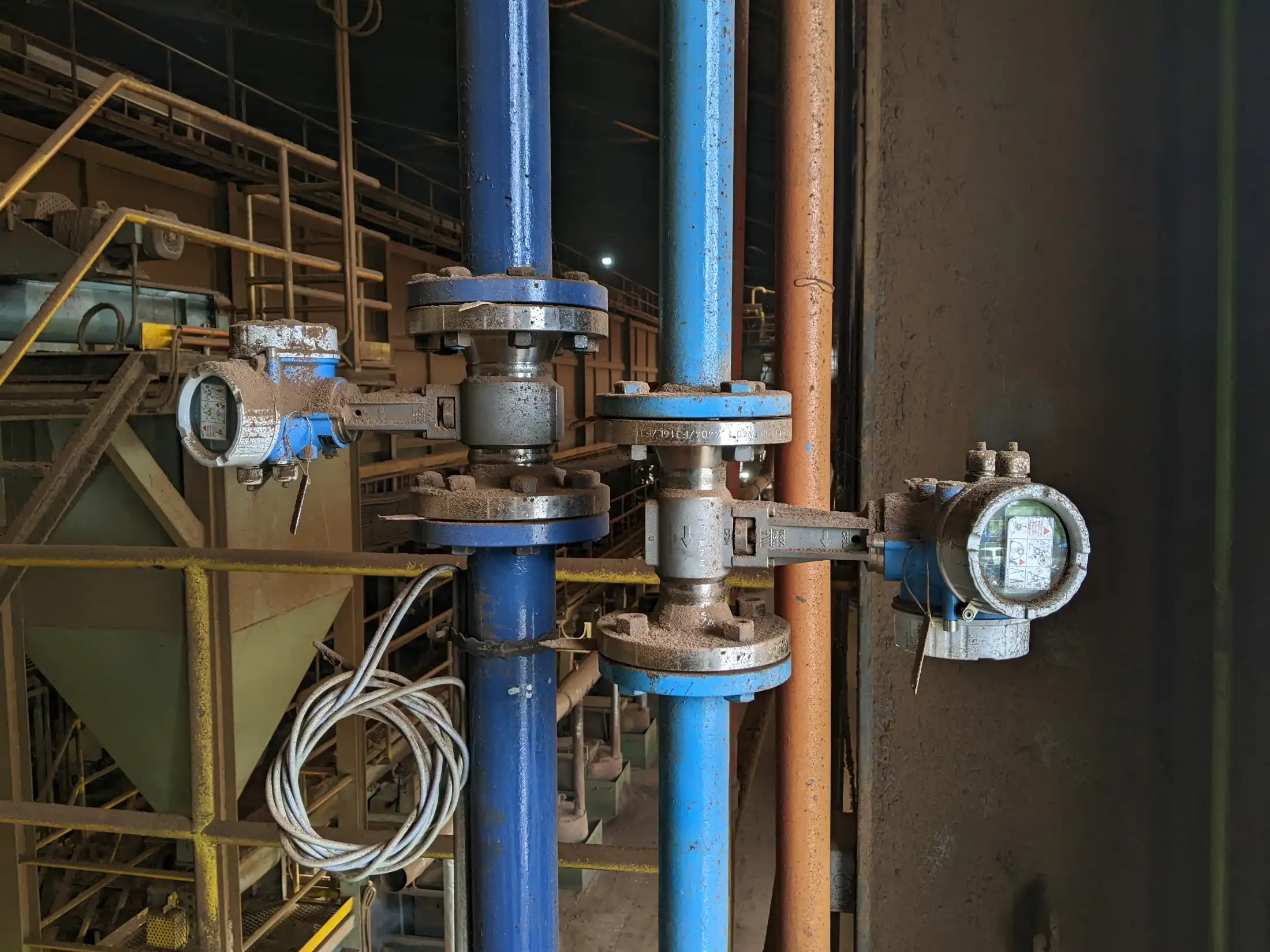
How do energy meters work? In a commercial building, an energy meter measures the energy a system actually consumes, then reports that number to the building automation system, to the utility, or to whoever allocates costs. The concept is straightforward. The execution is where buildings get into trouble, because the final reading depends on a chain of separate measurements, and the accuracy of that reading is limited by the weakest link in the chain.
This matters because conditioning and moving air and water is one of the largest line items in a commercial building. The U.S. Energy Information Administration reported that cooling accounted for roughly 14 percent of electricity use in U.S. commercial buildings in 2018, with another 18 percent going to ventilation. When close to a third of your electricity is spent moving air and water, the instruments measuring that movement deserve attention.
This guide covers what an energy meter measures, how the measurement chain actually works, where meters get installed, what building teams do with the data, and what causes an otherwise good meter to report a number nobody should trust.
What This Guide Covers
- What an energy meter measures in a commercial building
- How do energy meters work: the three-part measurement chain
- How do energy meters work in a central energy plant
- What building teams do with the data
- Why accuracy is the whole point
- What code requires for energy metering
- How to specify a meter that stays accurate
- Frequently asked questions
What an Energy Meter Measures in a Commercial Building
The phrase “energy meter” covers two very different instruments, and confusing them is the fastest way to end up with the wrong device on the wrong system.
Electric Submetering Versus Thermal Energy Metering
An electric meter measures electrical consumption in kilowatt hours. It samples voltage and current, multiplies them, and accumulates the result over time. Utility meters and panel-level submeters both work on this principle, and they tell you how much electricity a load consumed.
A thermal energy meter measures heat. In a hydronic system, the energy that heats or cools a space is carried by water, not electricity, so counting kilowatt hours at a panel tells you nothing about how much cooling a floor actually received. That is the job of a thermal energy meter, commonly called a BTU meter. Thermal energy monitoring, tenant submetering, and energy verification are all applications we support directly.
Both belong in a complete energy metering strategy. Only one of them can tell you what a chilled water loop delivered.
Why BTU Is the Unit That Matters in Hydronic Systems
A BTU is the energy required to raise one pound of water by one degree Fahrenheit. It is the natural unit for hydronic measurement because water is the transport medium, and the amount of heat the water gave up or picked up is exactly what you want to know.
That framing leads directly to the measurement itself. If you know how much water moved and how much its temperature changed, you know how much energy was transferred. Thermal energy (BTU) meters exist to make that calculation continuously and reliably.
How Do Energy Meters Work? The Three-Part Measurement Chain
A thermal energy meter is not one instrument. It is three, working together, and each one contributes its own error to the final number.
The Flow Sensor
The flow sensor measures how much water is moving through the pipe. Several technologies serve this role in building systems. Electromagnetic meters induce a voltage across the conductive fluid and read velocity from it. Ultrasonic meters compare the transit time of sound pulses traveling with and against the flow. Turbine meters count the rotation of a rotor placed in the stream. Each has a usable velocity range, an accuracy specification, and its own straight run requirement, and those differences decide which one belongs in your pipe. The flow and energy products we represent cover the technologies most commonly specified for chilled water, hot water, and condenser water service.
The Supply and Return Temperature Sensors
Two matched temperature sensors read the fluid entering and leaving the load. The meter needs the difference between them, not the absolute values, so the pair has to be matched and calibrated together.
This differential temperature measurement — not the flow sensor — is usually the largest single contributor to total system error. A small offset between two otherwise accurate sensors produces a differential error that carries straight into the energy calculation, and it does not average out over time the way some flow error does.
This is especially unforgiving on chilled water systems running a narrow delta T. When the temperature difference across the coil is only a few degrees, a fraction of a degree of sensor error becomes a large percentage of the measured value. On a system running a 10°F delta T, a matched pair with just 0.2°F of combined offset already represents a 2 percent error in the temperature term alone, before any flow error is added on top of it.
The Calculator, and the Math It Runs
The calculator, sometimes called the flow computer or integrator, takes flow rate and temperature differential and produces instantaneous power and accumulated energy. The core relationship is simple: energy transfer equals flow rate multiplied by the temperature difference multiplied by the fluid’s density and specific heat.
That last part is why fluid properties matter. Glycol in a system changes both density and specific heat, and a calculator configured for pure water will report the wrong number in a glycol loop no matter how accurate the flow sensor and temperature sensors are. The calculator then outputs the result to the building automation system over BACnet, Modbus, or an analog signal, or displays it locally for manual reads.
How Do Energy Meters Work in a Central Energy Plant?
Placement determines what a meter can tell you. The same technology installed in two locations answers two entirely different questions.
Central Plant and Building Entry Points
At a central energy plant, meters at the chiller and boiler outputs measure what the plant produced. Meters at each building’s service entrance measure what that building consumed. The difference between the two is your distribution loss, and on a large campus that difference is often larger than anyone expects.
Campus and district systems rely on this arrangement to bill buildings for actual consumption rather than by square footage. Universities, hospitals, and government facilities all use plant-level BTU metering for exactly this purpose.
Tenant and Floor Level Submetering
Inside a building, submeters at floor or tenant boundaries allocate heating and cooling costs to the parties that used them. BTU metering makes that allocation defensible, because it is based on measured energy transfer rather than an assumption about occupancy or area.
Chilled Water and Hot Water Branch Metering
Branch level metering is diagnostic work. A chilled water flow meter on a single air handler tells you whether that unit is receiving design flow, and pairing it with temperature sensors tells you whether it is transferring design capacity. When a zone is chronically warm, that pair of readings usually settles the argument about whether the problem is water side or air side. If the readings do not add up, our troubleshooting and optimization support covers flow and measurement validation on systems already in operation.
What Building Teams Do With the Data
Metering is not an end in itself. The value comes from the decisions the data supports.
Cost Allocation and Tenant Billing
Multi-tenant buildings, medical office complexes, and mixed-use properties all need to recover heating and cooling costs fairly. BTU metering replaces estimated allocations with measured ones, which removes most of the disputes before they start.
Verifying the Building Operates as Designed
Design intent and operating reality diverge over time. Valves stick, sequences get overridden, sensors drift, and pumps get rebalanced during a renovation nobody documented. Metered data is how you find that out, and verification of flow and energy performance at startup establishes the baseline you are comparing against later. The 2018 CBECS data showing that ventilation, lighting, and cooling represent the largest electricity end uses in commercial buildings is a reminder of where the recoverable money sits.
Feeding the Building Automation System
Energy data flowing into the automation system enables sequences that would otherwise be impossible: plant staging based on actual load, demand limiting, chilled water reset driven by measured performance, and alarming when consumption departs from a known baseline. The meter becomes an input to control, not just a record for reporting.
Why Accuracy Is the Whole Point
An inaccurate meter is worse than no meter, because it produces confident numbers that lead to wrong decisions.
How Error Compounds Through the Chain
Total system accuracy is the combined effect of flow measurement error, temperature measurement error, and calculator error. A flow sensor rated at plus or minus 1 percent paired with a marginal temperature pair does not give you a 1 percent system. It gives you something meaningfully worse, and on a system where HVAC accounts for a substantial share of the building’s electricity, as NREL’s analysis of commercial building energy use documents, that error translates directly into misallocated dollars.
This is why a specification that names an accuracy figure without saying which component it applies to is not really a specification. Ask whether the number refers to the flow element alone or to the assembled thermal energy meter, and ask over what flow range it holds.
Low Flow Conditions and Where Volumetric Technologies Struggle
Modern systems are designed to run at part load most of the time, and variable flow pumping pushes velocities well below one foot per second during shoulder seasons. Several volumetric technologies either lose accuracy or stop registering entirely in that range. A meter that performs beautifully at design flow and reports nothing at 20 percent load is not measuring your building; it is measuring your best day.
Turndown ratio is the specification that captures this. Ask for it, and compare it against the actual operating range of the system rather than the design condition on the schedule.
Straight Run, Installation Position, and Profile Disturbance
Most velocity-based technologies need a fully developed flow profile to deliver rated accuracy. Elbows, reducers, tees, and valves upstream of the meter create swirl and asymmetry, and the meter reads that disturbance as flow. The common requirement is a stated number of pipe diameters of straight run upstream and downstream, and it varies significantly by technology.
Mechanical rooms rarely offer generous straight run. That constraint should drive technology selection at the design stage, not become a field problem discovered during startup.
What Does Code Require for Energy Metering?
Metering is increasingly not optional. ASHRAE Standard 90.1 requires new buildings to separately monitor major load categories, and Section 8.4.3 covers total electrical energy, HVAC systems, interior and exterior lighting, and receptacle circuits. Recent editions of the IECC contain parallel provisions, and both paths address interval data, retention, and reporting.
On the federal side, the Department of Energy’s Federal Energy Management Program publishes metering guidance and a metering best practices resource that many institutional owners use as a reference even when they are not federally obligated. If your project is on a campus, in healthcare, or in a government facility, expect the metering scope to be reviewed closely.
How to Specify an Energy Meter That Stays Accurate
The questions worth answering before selecting a technology are consistent across projects:
- What fluid is in the pipe, and does it contain glycol or other additives
- What is the pipe size and pipe material
- What is the full operating flow range, not just design flow
- How much straight run is actually available at the intended location
- Can the system be shut down for installation, or does this need to be a non-invasive or hot tap solution
- What accuracy does the application require, and is that for billing, control, or monitoring
- What signal and/or protocol does the building automation system need
Answer those seven questions and the technology choice usually becomes obvious. Skip them and the selection gets made by whatever was cheapest at bid.
This is also where specification and application support earns its keep. Our team assists MEP engineers with specification development and editing for the products and applications we represent, so the language in the spec matches the application before the project reaches bid. From there, we handle product selection, submittal review and coordination, factory coordination, and support through installation, startup, and commissioning, which keeps a technology mismatch from becoming a field problem the contractor absorbs.
Conclusion
So, how do energy meters work in a commercial building? A flow sensor measures how much water moved, matched temperature sensors measure how much its temperature changed, and a calculator turns those inputs into BTUs. The principle has not changed in decades. What separates a meter that informs decisions from one that misleads them is whether the technology was matched to the fluid, the pipe, and the real operating range of the system.
If you are specifying energy metering on a new project or trying to make sense of readings on an existing building, we can help you get the selection right the first time. Request a quote for your project and our team will work through the application with you, or get in touch if you would rather start with a conversation.
Frequently Asked Questions
How do BTU meters work? A BTU meter combines a flow sensor with a matched pair of supply and return temperature sensors and a calculator. It multiplies the measured flow rate by the temperature difference and by the fluid’s density and specific heat to produce thermal energy in BTUs. Understanding how do BTU meters work is really a matter of understanding those three components and how their errors combine.
What is the difference between an energy meter and a flow meter? A flow meter measures volume or mass moving through a pipe. An energy meter measures energy transferred, which requires flow plus a temperature differential. Every thermal energy meter contains a flow meter, but a flow meter on its own cannot report energy. Both are covered in the products we represent.
Where should a chilled water flow meter be installed? Install it where the available straight run satisfies the manufacturer’s requirement for that technology, in a full pipe, and in a location that is accessible for service and verification. Vertical runs with upward flow help keep the pipe full and reduce air entrainment. Confirm the location during design rather than resolving it during startup.
Does energy metering require a building automation system? No, but it is where most of the value lives. Meters can display locally and be read manually, which satisfies basic energy metering and reporting needs. Integrating them into the automation system enables trending, alarming, and control sequences that respond to measured load.
Can existing buildings add BTU metering without shutting down? Yes, in many cases. Non-invasive clamp-on and hot tap installation methods allow flow measurement to be added to an operating system, though each carries its own accuracy and pipe condition considerations. The right approach depends on pipe material, size, and the accuracy the application requires. A building or system survey is usually the fastest way to confirm what a given pipe will support.